Every medical record, cited to the page.

The treatment record is organized around the injuries, visits, providers, and gaps that shape the medical story.

Schedule a call

The whole record, line by line.

Context handles the paperwork, so attorneys get back to strategy and case managers get back to clients. Every treatment fact surfaced, verified, and traced to its source.

Provider

Treating physician and facility names on every encounter, organized with the visits they documented.

Encounters

Every visit with date, specialty, clinical notes, and whether it is related to the incident, ready for case-wide review.

Incident details

How the injury occurred, when it happened, and the circumstances documented in the record.

Diagnoses and clinical details

Diagnoses, medications, medical history, chief complaints, and clinical notes organized across the course of treatment.

Objective injuries

Imaging, range-of-motion findings, orthopedic test results, and other objective findings organized by injury.

Treatment chronology

Every visit across providers in date order, from the first post-incident encounter through the latest record.

Red flags

Pre-existing conditions, treatment gaps, inconsistencies, and unrelated treatment flagged to your firm's thresholds.

The whole record, reconciled.

Every visit extracted, every injury evidenced, every flag surfaced. The full treatment picture at a glance.

Encounters
DateMedical RecordBill
Mar 14
Acute cervical and lumbar complaints following MVA
RelatedEmergency
Coastal Regional ER
$4,2003 charges
Coastal Regional ER
Apr 2
Cervical ROM deficit, lumbar imaging ordered
RelatedDiagnostic
Dr. M. Torres
$1,8502 charges
Midwest Ortho Group
Apr 18
L4-L5 disc herniation, mild foraminal narrowing
RelatedDiagnostic
Central Imaging
$3,2004 charges
Central Imaging
May 6
Lumbar stabilization, 60% flexion improvement
RelatedPhysical Therapy
Dr. S. Chen
$9001 charges
ProMotion PT

Every visit, matched to its bill

The full course of treatment with provider, specialty, and clinical notes, each visit tied to its charges and marked related or unrelated to the incident.

Objective Injuries
Cervical Spine
Coastal Regional ER
C5-C6 disc herniation with central canal effacement on MRI. Axial neck pain radiating to the right upper extremity documented on initial ER visit.
Right-sided foraminal stenosis with C6 radiculopathy confirmed on EMG (Jan 5). Cervical rotation limited to 30° bilaterally on exam.
Lumbar Spine
Central Imaging
L4-L5 disc herniation with mild foraminal narrowing. Nucleus pulposus material contacting the descending L5 nerve root on sagittal T2 imaging.
Midwest Ortho Group
Positive straight leg raise at 45° on the left. Paraspinal muscle spasm and guarded lumbar flexion to 40° on orthopedic evaluation.
Associated Findings
Coastal Regional ER
Paracervical muscle spasm and tenderness over the trapezius. No fracture or dislocation on cervical spine X-ray at the receiving facility.
ProMotion PT
Left shoulder ecchymosis and tenderness over the acromion, consistent with seatbelt contact. Full active range of motion by week 3 of PT.

Evidence behind every injury

Imaging, exams, and test results extracted from the record, tied to the providers who documented them.

Red flags
Pre-existing condition
Coastal Regional ER
Lumbar disc herniation documented prior to incident date on MRI from 2019, noted in the ER intake history.
Prior L4-L5 degenerative changes referenced in nursing notes but not addressed in the post-incident treatment plan.
Treatment gap
Case timeline
No records between Jan 15 ER visit and Feb 28 neurology consult, a 44-day gap with no documented treatment.
Patient reported ongoing lumbar pain during the neurology visit, suggesting symptoms continued through the gap.
Clinical inconsistency
Central Imaging
Clinical notes describe acute onset after the MVA; imaging shows chronic degenerative changes at L4-L5 with Modic type II endplate changes.
ER provider documented severe acute pain; MRI impression characterizes findings as long-standing disc disease.

Problems found before they find you

Pre-existing conditions, treatment gaps, and inconsistencies between the notes and the objective findings, flagged with the reasoning behind each one.

Context is already on it.

New documents are processed the moment they arrive in your system. No uploads, no batching, no one pressing go.
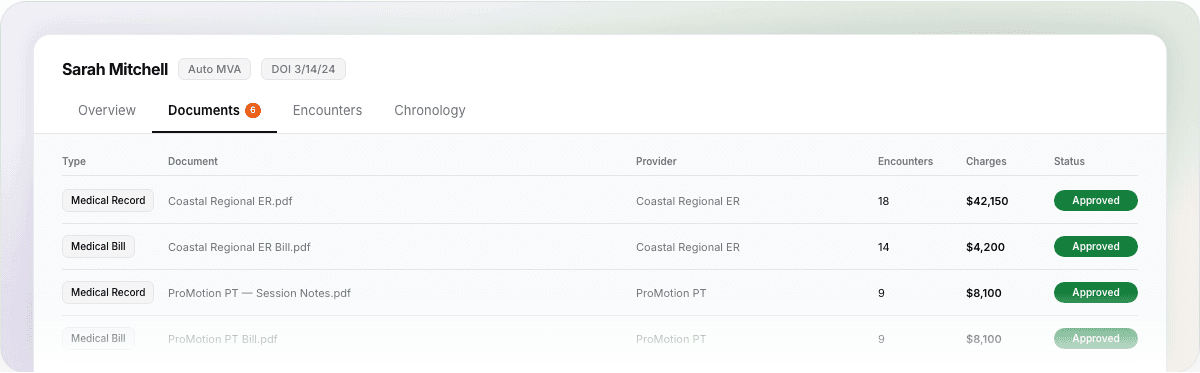
Sarah MitchellAuto MVADOI 3/14/24
Overview
Documents6
Encounters
Chronology
TypeDocumentProviderEncountersChargesStatus
Medical RecordCoastal Regional ER.pdfCoastal Regional ER18$42,150Unapproved
Medical BillCoastal Regional ER Bill.pdfCoastal Regional ER14$4,200Unapproved
Medical RecordProMotion PT — Session Notes.pdfProMotion PT9$8,100Unapproved
Medical BillProMotion PT Bill.pdfProMotion PT9$8,100Unapproved
Medical RecordCentral Imaging MRI Report.pdfCentral Imaging3$3,200Unapproved
Police ReportAustin PD Crash Report.pdfAustin PDUnapproved
  1. Documents found automatically
    01
    Documents found automaticallyRecords, bills, and police reports sync from the systems you already use.
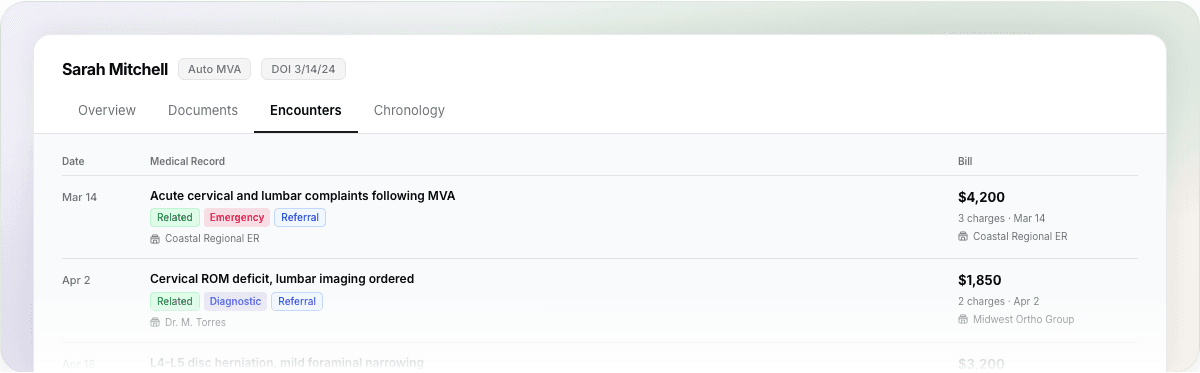
  2. Documents become case facts
    02
    Documents become case factsEncounters, charges, diagnoses, injuries, and liability facts are extracted from every page.
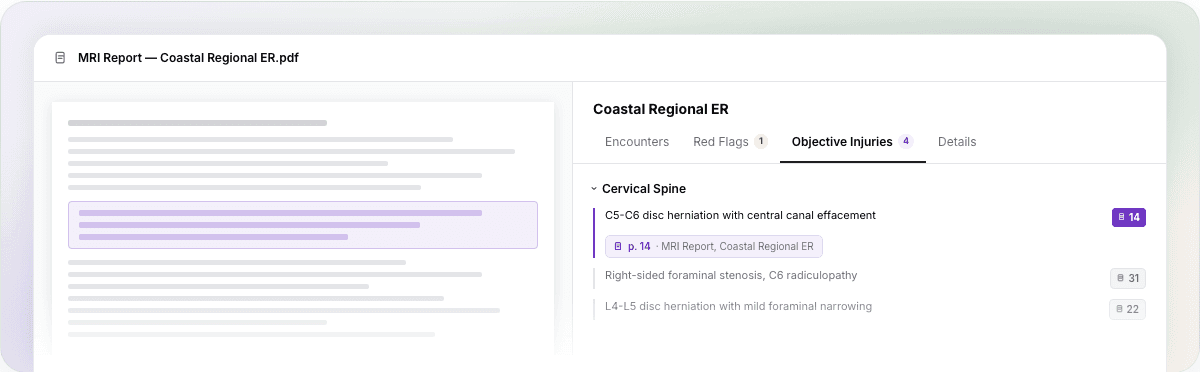
  3. Findings link to source pages
    03
    Findings link to source pagesEvery finding points to the exact language in the record it came from.
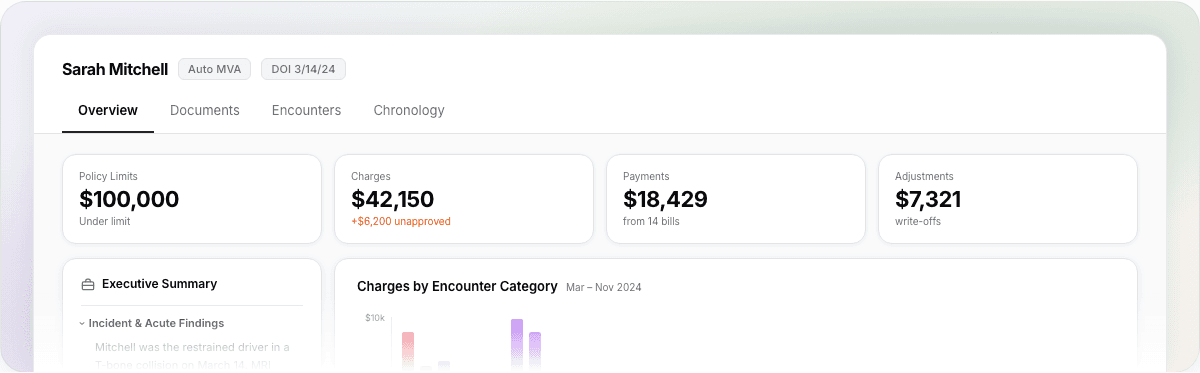
  4. The case file fills itself in
    04
    The case file fills itself inReviewed findings flow straight into your case file, in the system you already use.

FAQs

Answers to frequently asked questions about Context.

A treatment record your team can review in one place: visits, injuries, diagnoses, clinical details, and issues worth a second look. Every finding ties back to the page in the original document.

Every finding ties to the page in the source record where it appears. Your team can verify everything against the original PDF and sign off before anything informs the case.

Items that may need closer review: pre-existing conditions before the incident, gaps between visits, inconsistencies, and unrelated treatment flagged to your firm's thresholds. They surface early; they do not block your team from approving the record.

Each record is processed on its own. Visits from different providers come together on one case timeline, ordered by date, so your team follows the full treatment story without rebuilding it by hand.

No. Context reads records from the systems you already use and returns findings your team verifies and approves. Your CMS stays in place.

See Context on a real case.

Schedule a call and we'll walk through a real case: what gets found, what gets flagged, and how your team verifies it.

Schedule a call